The Sternberg Memory Task
In 1966, Saul Sternberg ran a now-famous experiment on people's short-term memory abilities. He presented 1–6 digits for a person to remember, and shortly thereafter presented another number that either was or was not in the set the person memorized. He found that the average response time was a linear function of the number of digits memorized, and the same slope applied whether the item was in the list or not — positive responses are faster overall, but the two lines are parallel. An interpretation given by Sternberg is that people serially and exhaustively scan the list in memory to check for matches, which is why the slopes are the same. If the scan terminated when people found a match, we'd expect a smaller slope for positive responses on average, but this isn't what we see.
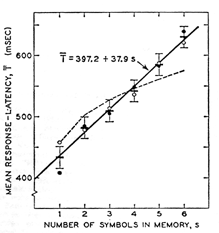
At larger set sizes — around 10–15 symbols — the linear relationship breaks down, and people actually get faster at scanning as there are more symbols in memory. It is not known precisely why or how this is the case.
Here, you can try it for yourself! Typically people scan at 25–30 items/second (~38ms/item), and the scanning rate seems to have negligible relation with intelligence.
You'll be shown a set of numbers for 1.5 seconds, which will disappear and be replaced with a single number. Press F if this number was in the set, J if not. On mobile, use the buttons.
F Yes J No
Accuracy: Trials:
Scanning rate:
Getting an accurate estimate of your scanning rate takes around 6 trials per set size at least — the linear trend will become more clear as you do more trials.